Call Tracking Setup for Multi-City Campaigns
Attribution rules that stop local campaigns from cannibalizing each other.
Multi-city campaigns underperform when all inbound calls are treated as one source. If Johannesburg, Pretoria, and Cape Town traffic share identical tracking numbers, budget decisions become guesswork and winning segments stay hidden. Use dynamic numbers at campaign and location level, then map each call to source, keyword, and landing page path. This reveals which local offer actually drives qualified conversations rather than generic call volume.
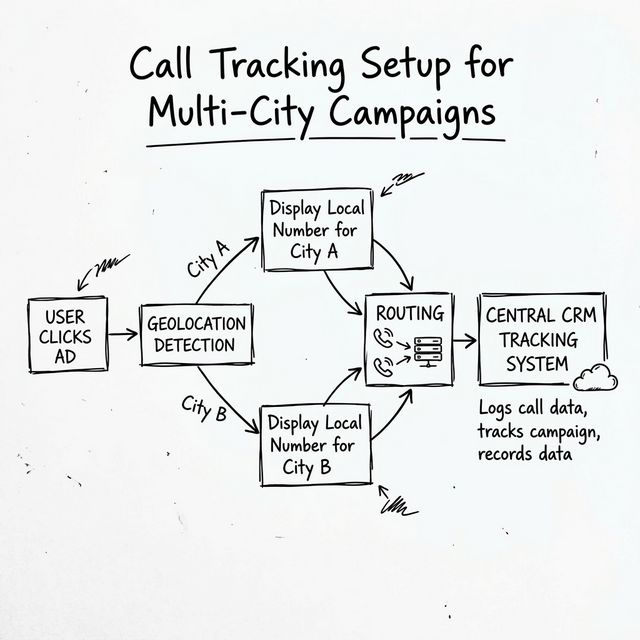
That is where budget and strategy decisions become materially better. A practical improvement path is to harden event tracking, standardize channel naming, and audit conversion definitions monthly. This prevents reporting drift from quietly damaging performance. Once data quality is stable, teams can optimize for business outcomes with far less volatility in results.
If attribution is noisy, even good campaigns can be scaled in the wrong direction. The best setup links acquisition source, landing context, and downstream sales outcomes into one view. That is where budget and strategy decisions become materially better. A practical improvement path is to harden event tracking, standardize channel naming, and audit conversion definitions monthly.
Analytics is not a reporting layer, it is a decision layer. If data is inconsistent, strategy quality declines even when tactical execution is strong. Build your measurement model around business outcomes first, then map events and dashboards to those outcomes. This avoids optimization based on vanity metrics.
Attribution quality improves when event naming, channel taxonomy, and conversion definitions are standardized. Without these standards, teams compare incompatible numbers and make conflicting decisions. Establish one source of truth for key metrics and audit it regularly. Consistency is what enables confident optimization.