Offer Stacking for Service Businesses
How to bundle bonuses without devaluing your core service.
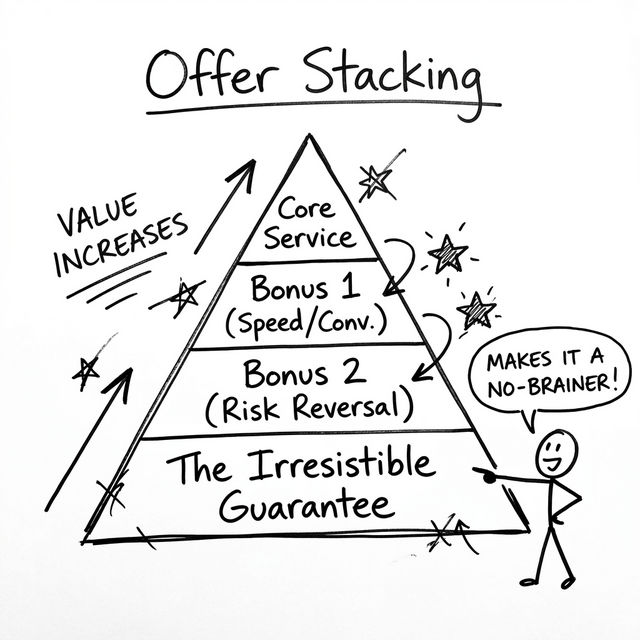
Offer stacking works best when each element removes a specific objection instead of adding random bonuses. Buyers hesitate because of risk, timeline uncertainty, and unclear outcomes, so your stack should answer those three points directly. A strong structure is core service plus implementation roadmap, proof pack, and a clear confidence guarantee tied to deliverables. This framing increases perceived value without discounting your main offer or training prospects to wait for price drops.
Small clarity gains can produce large performance lifts. A useful operating model is to pair behavioral data with weekly experiments, then promote winners into your default templates. This compounds conversion rate over time. When teams focus on buyer intent and trust signals, conversion growth becomes repeatable instead of random.
Prospects need clear outcomes, believable proof, and obvious next steps. If those elements are weak, even high traffic volume underperforms. Start by mapping the top objections on each page and adding specific trust and clarity elements where hesitation occurs. Testing should be run as a sequence of focused experiments, not broad redesign bursts.
Prioritize high-impact variables like value framing, CTA context, and friction around first action. Measure both volume and quality outcomes so gains are commercially meaningful. A lift in submissions is not useful if close rate deteriorates. Behavioral data is your guide to where conversion breaks.
Session recordings, scroll patterns, and abandonment points reveal where users lose confidence. Pair those observations with targeted copy and layout changes so each iteration solves a specific problem. This approach produces steady progress and reduces wasted design cycles. High-performing conversion systems are built through compounding micro-improvements.